Recently, someone left my office at Newcastle University and a new person took their place, so we needed a new sign on our front door. I wanted to do something clever with it, but it needed to be instantly legible to lost supervisors trying to find their students.
My first thought was that since there are seven of us, something to do with the Fano plane would look good. Our names didn’t have enough of the right letters in the right places for it to work, though.
That got me thinking about the Levenshtein distance. The Levenshtein distance between two strings is a measure of how many changes you need to make to one to end up with the other. I wrote a Python script which calculated the distance between each pair of names:
from itertools import combinations
def lev(s1, s2): #from wikibooks: http://en.wikibooks.org/wiki/Algorithm_Implementation/Strings/Levenshtein_distance#Python s1,s2=[x.lower() for x in (s1,s2)] if len(s1) < len(s2): return lev(s2, s1) if not s1: return len(s2) previous_row = range(len(s2) + 1) for i, c1 in enumerate(s1): current_row = [i + 1] for j, c2 in enumerate(s2): insertions = previous_row[j + 1] + 1 # j+1 instead of j since previous_row and current_row are one character longer deletions = current_row[j] + 1 # than s2 substitutions = previous_row[j] + (c1 != c2) current_row.append(min(insertions, deletions, substitutions)) previous_row = current_row return previous_row[-1]
def levgraph(names): dist = [(lev(x,y),x,y) for x,y in combinations(names,2)] dist.sort(key=lambda x:x[0]) got=set() edges=[] while(len(got)<len(names)): d,x,y = dist[0] got.update((x,y)) edges.append((d,x,y)) dist=[(d,x,y) for d,x,y in dist if x not in got or y not in got] return edges
if __name__ == '__main__': names=['Stacey Aston','Nathan Barker','Matthew Buckley','David Elliott','Michael Garrett','Christian Perfect','Daniel Wacks'] edges = levgraph(names) f=open('lev.gv','w') f.write('graph PHD2 {\n\tratio=0.55;fontname="Calibri";fontsize=24;label="PHD2";size="5.374,4.5";margin=0;\n\n\tnode [shape=none,fontname="Calibri",fontsize=20];\n') [f.write('\t"%s";\n' % x) for x in names] f.write('\n') [f.write('\t"%s" -- "%s" [len=%f,label=%i];\n' % (x,y,d*.15,d)) for d,x,y in edges] f.write('}') f.close() print('\n'.join('%i %s, %s' % edge for edge in edges))
This is equivalent to a complete weighted graph, so I got it to find a minimal spanning tree:
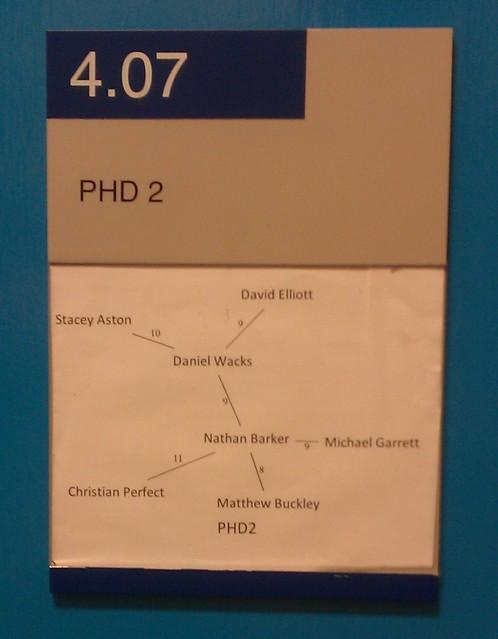
8 nathan barker, matthew buckley9 nathan barker, michael garrett9 nathan barker, daniel wacks9 david elliott, daniel wacks10 stacey aston, daniel wacks11 nathan barker, christian perfectI then made it produce a GraphViz file,
graph PHD2 { ratio=0.55;fontname="Calibri";fontsize=24;label="PHD2";size="5.374,4.5";margin=0;
node [shape=none,fontname="Calibri",fontsize=20]; "Stacey Aston"; "Nathan Barker"; "Matthew Buckley"; "David Elliott"; "Michael Garrett"; "Christian Perfect"; "Daniel Wacks";
"Nathan Barker" -- "Matthew Buckley" [len=1.200000,label=8]; "Nathan Barker" -- "Michael Garrett" [len=1.350000,label=9]; "Nathan Barker" -- "Daniel Wacks" [len=1.350000,label=9]; "David Elliott" -- "Daniel Wacks" [len=1.350000,label=9]; "Stacey Aston" -- "Daniel Wacks" [len=1.500000,label=10]; "Nathan Barker" -- "Christian Perfect" [len=1.650000,label=11];}
which produced this image:

